Characteristics
| Hardiness zone | 6b |
|---|---|
| Flower color | butter |
| Foliage type | evergreen |
| Plant form | upright spreading |
| Mature height | 50 feet |
| Spread | 50 feet |
| Light requirements | full sun |
| Moisture requirements | average to moist |
| Plant origin | import |
Houston's favorite garden center devoted to Texas native plants and organic gardening.
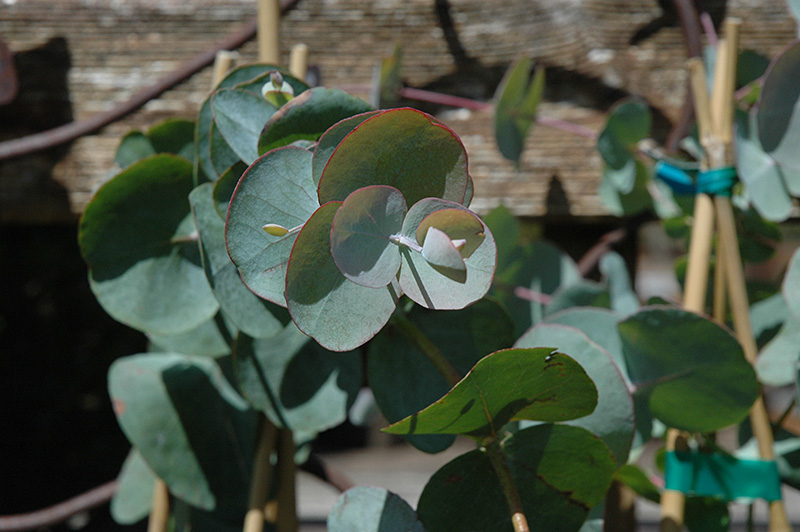
Botanical name: Eucalyptus cinerea
Foliage is very ornamental and widely used in fresh or dried floral arrangements; a beautiful landscape specimen, alone or in groups; can be pruned back to the ground like a perennial shrub in cooler climates.
Other names: Argyle Apple
| Hardiness zone | 6b |
|---|---|
| Flower color | butter |
| Foliage type | evergreen |
| Plant form | upright spreading |
| Mature height | 50 feet |
| Spread | 50 feet |
| Light requirements | full sun |
| Moisture requirements | average to moist |
| Plant origin | import |
Silver Dollar Eucalyptus has attractive bluish-green foliage. The fragrant round leaves are highly ornamental and remain bluish-green throughout the winter. Neither the flowers nor the fruit are ornamentally significant.
Silver Dollar Eucalyptus is an evergreen tree with an upright spreading habit of growth. It lends an extremely fine and delicate texture to the landscape composition which can make it a great accent feature on this basis alone.
This tree will require occasional maintenance and upkeep, and can be pruned at anytime. It has no significant negative characteristics.
Silver Dollar Eucalyptus is recommended for the following landscape applications;
Accent, Shade, Vertical Accent
Silver Dollar Eucalyptus will grow to be about 50 feet tall at maturity, with a spread of 50 feet. It has a low canopy with a typical clearance of 4 feet from the ground, and should not be planted underneath power lines. It grows at a fast rate, and under ideal conditions can be expected to live for 60 years or more.
This tree should only be grown in full sunlight. It does best in average to evenly moist conditions, but will not tolerate standing water. It is particular about its soil conditions, with a strong preference for sandy, acidic soils, and is able to handle environmental salt. It is somewhat tolerant of urban pollution. This species is not originally from North America.