Characteristics
| Hardiness zone | 8b |
|---|---|
| Flower color | crimson |
| Foliage type | evergreen |
| Plant form | arching |
| Mature height | 8 feet |
| Spread | 6 feet |
| Light requirements | full sun to partial shade |
| Moisture requirements | average to moist |
| Plant origin | hybrid |
Houston's favorite garden center devoted to Texas native plants and organic gardening.
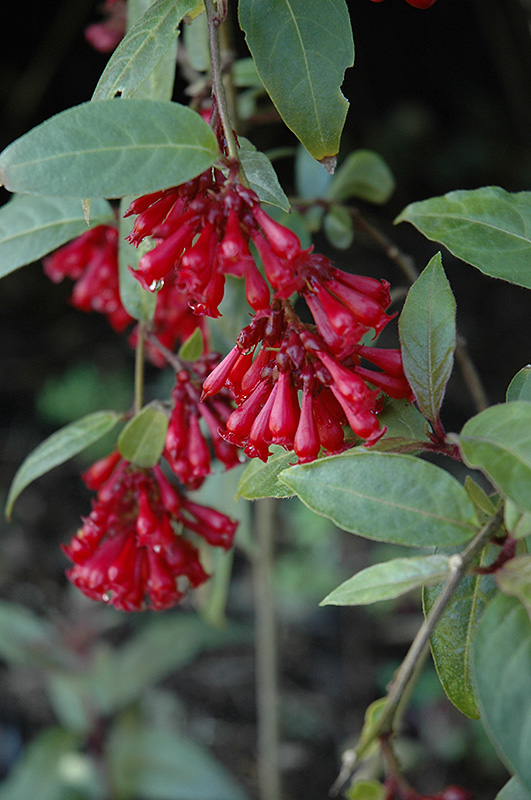
Botanical name: Cestrum ‘Newellii’
This stunning evergreen shrub produces showy masses of crimson tubular flowers over a long period followed by interesting red berries; plant in sheltered area of the garden or along borders; may resprout from roots after a hard freeze;.
Other names: Jessamine
| Hardiness zone | 8b |
|---|---|
| Flower color | crimson |
| Foliage type | evergreen |
| Plant form | arching |
| Mature height | 8 feet |
| Spread | 6 feet |
| Light requirements | full sun to partial shade |
| Moisture requirements | average to moist |
| Plant origin | hybrid |
Red Cestrum features showy clusters of crimson tubular flowers at the ends of the branches from early spring to late winter. It has bluish-green foliage which emerges green in spring. The pointy leaves remain bluish-green throughout the winter. The fruit is not ornamentally significant.
Red Cestrum is a dense multi-stemmed evergreen shrub with a shapely form and gracefully arching branches. Its average texture blends into the landscape, but can be balanced by one or two finer or coarser trees or shrubs for an effective composition.
This is a relatively low maintenance shrub, and usually looks its best without pruning, although it will tolerate pruning. It is a good choice for attracting birds, bees and butterflies to your yard. It has no significant negative characteristics.
Red Cestrum is recommended for the following landscape applications;
Accent, Mass Planting, General Garden Use
Red Cestrum will grow to be about 8 feet tall at maturity, with a spread of 6 feet. It has a low canopy, and is suitable for planting under power lines. It grows at a medium rate, and under ideal conditions can be expected to live for approximately 30 years.
This shrub does best in full sun to partial shade. It does best in average to evenly moist conditions, but will not tolerate standing water. It is not particular as to soil type or pH. It is somewhat tolerant of urban pollution, and will benefit from being planted in a relatively sheltered location. Consider applying a thick mulch around the root zone in winter to protect it in exposed locations or colder microclimates. This particular variety is an interspecific hybrid.